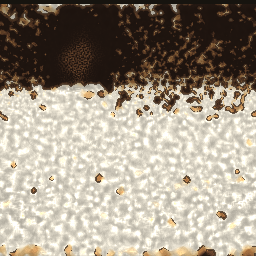
Before sealing a work, I construct and compare laws: shared systems of interaction capable of producing a visual world. These studies are not alternate editions of Unwoven Territory. They document the search through which one law was selected, tested, and accepted.
Many candidate laws are constructed and run. Their behaviors are compared; interactions that do not earn their place are removed; the surviving law is audited across many unseen inputs; and only then is it sealed — fixed permanently, with its outputs accepted rather than curated.
I understand this practice through jinen: form arising through conditions that are established but not fully controlled. The system is authored and may be deterministic, yet the world made possible by its interactions is not fully known in advance. The artist encounters its results after generation, as phenomena to be tested, accepted, or refused.
The Japanese ceramic idea of keshiki — qualities such as firing marks, flows, cracks, and tonal changes encountered as a landscape on the surface of a vessel — offers a way to describe this encounter. I do not claim a continuous historical lineage from Japanese art to computation. I find a structural resonance: the artist prepares conditions, transformation takes place, and what appears is subsequently discovered as keshiki.
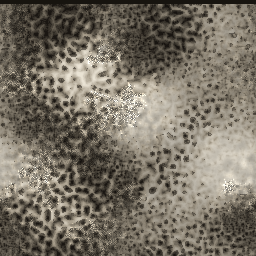
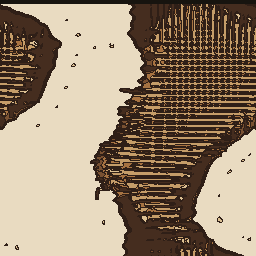
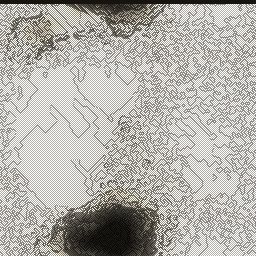
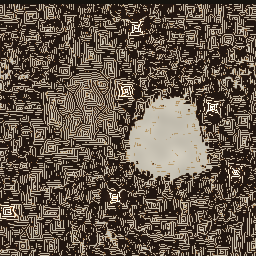
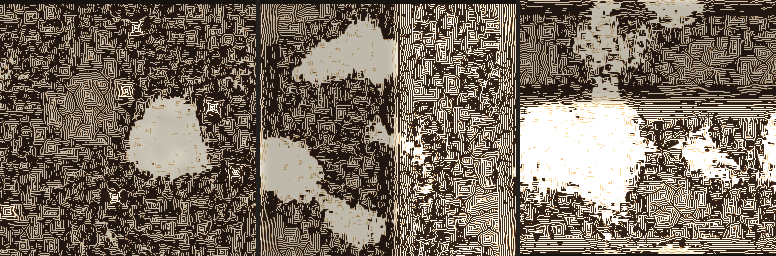
Six candidate laws were validated on shared audit walls. They are numbered as studies, not titled as projects. Studies are shown here in neutral validation renderings; the sealed palette belongs to the finished work.
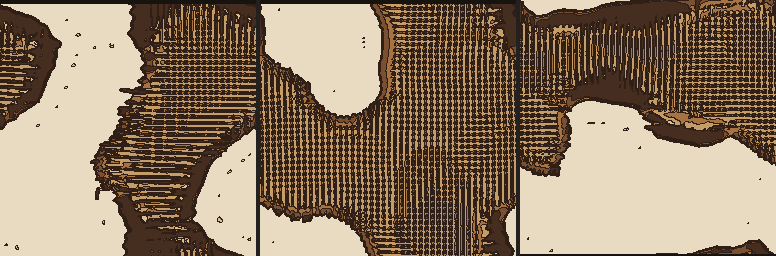
Can the removal of a weave generate territory?織りを退かせることで、領土は生まれるか?
What the law revealed法則が示したこと
As the weave developed it surrendered space, and the openings held together as territory rather than reading as damage or background.織りが進むほど場所が明け渡され、その開けた部分は欠損や背景ではなく、領土としてまとまりを保ちました。
Outcome帰結
Sealed. The law survived comparison and a 256-hash audit, and became Unwoven Territory.封印。比較と256ハッシュの監査を経て、《Unwoven Territory|ほどかれた領土》になりました。
Study 12
Developed August 2026制作時期 2026年8月
Question問い
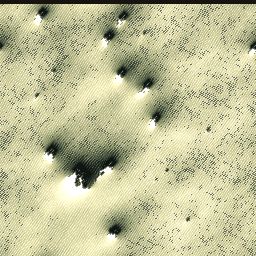
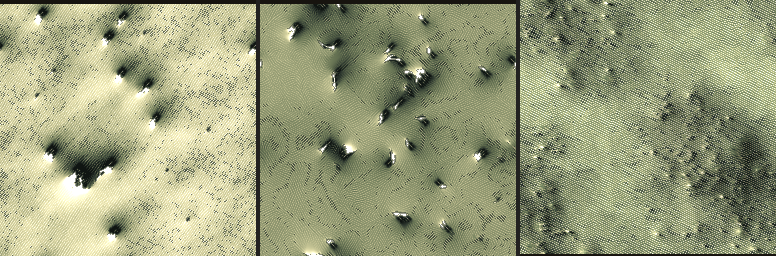
Can sparse, point-like events give structure to a quiet field?まばらな点状の出来事は、静かな場に構造を与えられるか?
What the law revealed法則が示したこと
A strong core of behavior formed: small raised marks organized the calm field around themselves.強い核となる振る舞いが成立しました。小さな隆起の痕が、周囲の静かな場を組織していきます。
Outcome帰結
Not sealed. Some outputs collapsed into weak bands, and one operation did not yet prove necessary. A law is sealed only when both its range and every operation can be accepted.封印せず。弱い帯状の出力が残り、一つの作用の必要性も証明できませんでした。出力の幅とすべての作用を引き受けられる法則だけを封印します。
Study 09
Developed August 2026制作時期 2026年8月
Question問い
Can a densely interlocked labyrinth still leave open ground?密に絡み合う迷路は、なお開けた地面を残せるか?
What the law revealed法則が示したこと
Stable openings formed inside a dense interlocking texture, reliably across the whole wall.密に絡む組織の内部に安定した開口が形成され、壁全体で再現されました。
Outcome帰結
Not sealed. The field stayed too dense, and the results felt familiar — the law was stable, but not a discovery.封印せず。場は過密なままで、結果には既視感がありました。安定はしていても、発見ではありませんでした。
Why Law 04 was sealedなぜ法則04が封印されたか
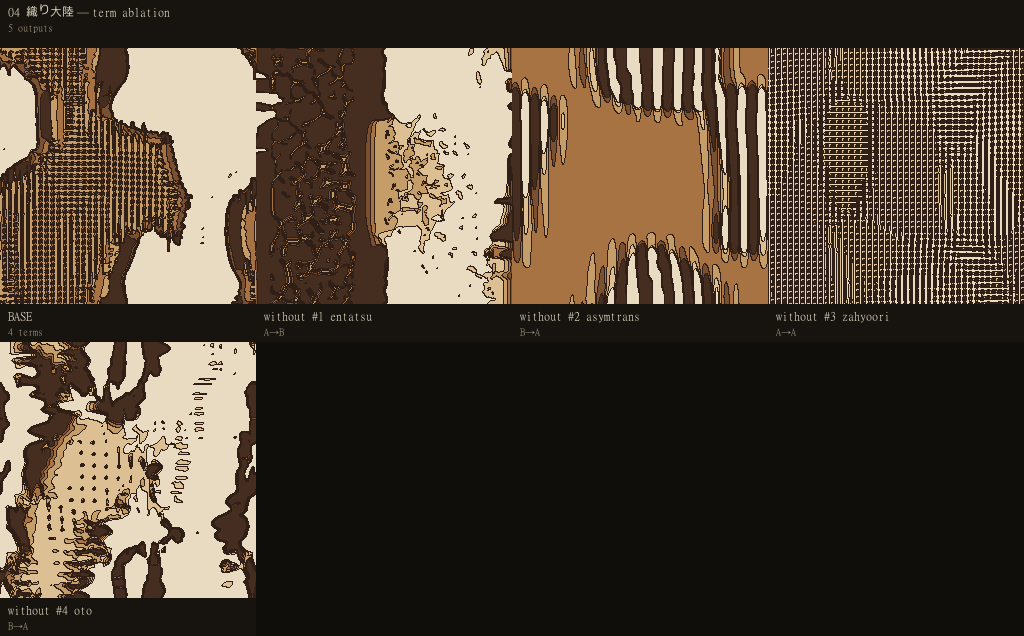
Study 09 was stable but crowded; Study 12 held a strong core whose parts never all proved necessary. Law 04 was the one law where every operation earned its place, where unseen hashes kept producing distinct territories rather than variations of one picture, and where the central question — a weave surrendering space — stayed visible at every scale. It survived comparison, passed a 256-hash audit without exclusions, and was sealed as Unwoven Territory.
The sealed law consists of four interactions. Removing any one of them and re-running the same hash produces a visibly weaker field. This ablation is how the necessity of each operation was tested before sealing.
August 20262026年8月Six candidate laws validated on shared audit walls. Studies 04, 09, and 12 compared in depth. Law 04 audited across 256 unseen hashes and sealed as Unwoven Territory.六つの候補法則を共通の監査壁で検証。スタディ04・09・12を詳細に比較。法則04を未見の256ハッシュで監査し、《Unwoven Territory|ほどかれた領土》として封印。